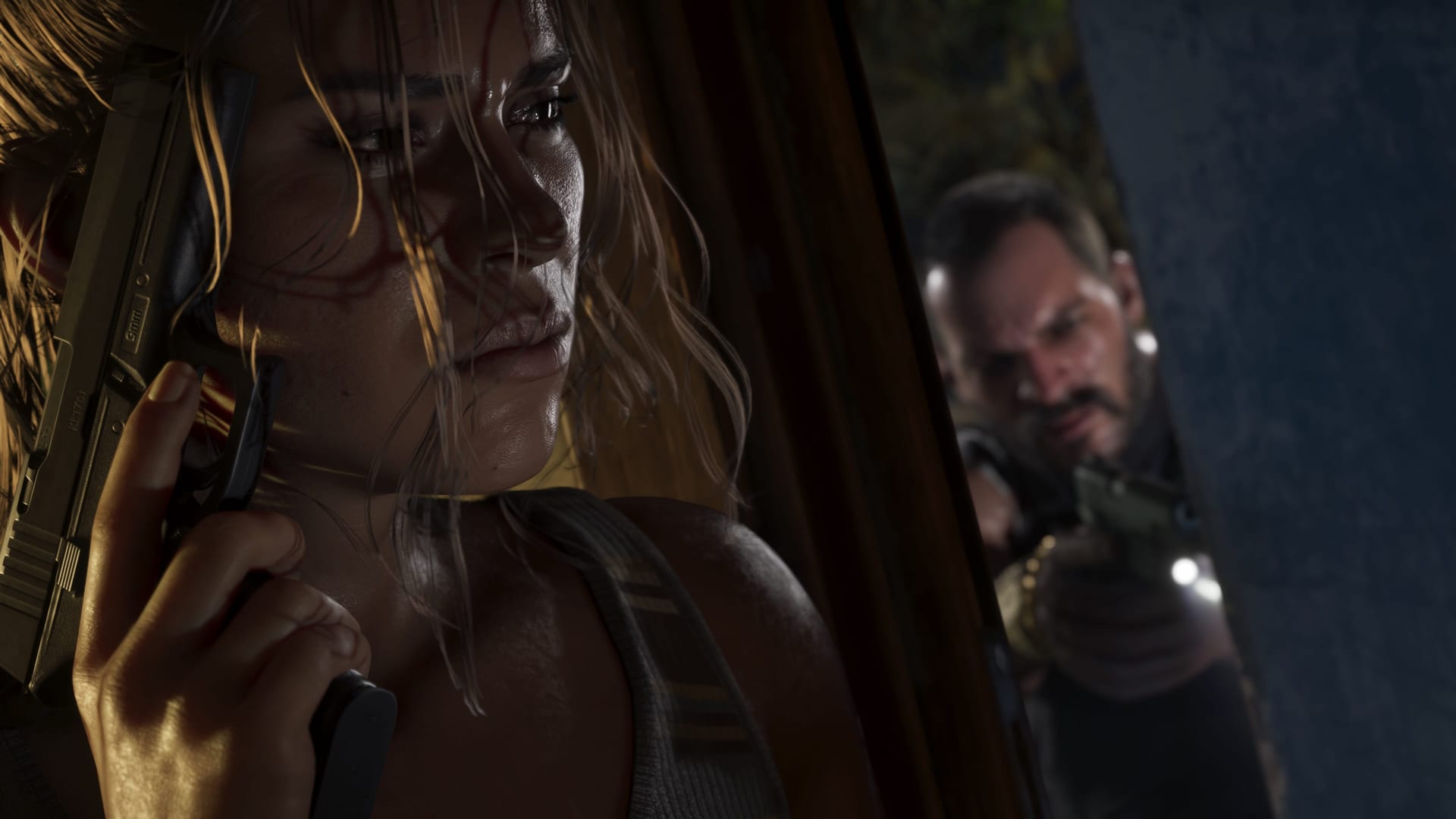
Six stars, and why that is the least interesting part
Official. The wanted meter in GTA 6 goes to six stars. That restores a ceiling the series carried through GTA IV and Chinatown Wars before GTA 5 cut it to five in 2013, and it was the headline most coverage led with when Rockstar published Grand Theft Auto VI: An Extended Look on August 27, 2026 — footage Rockstar says was captured in-game on a PlayStation 5.
The star count is the easy story, and it is also the only part of the system anybody can state with total confidence, because Rockstar showed the meter on screen in its own video. Everything else on this page is either something Rockstar said in an interview or something journalists read off a HUD while watching somebody else play — and those are different grades of evidence, so this page keeps them apart.
The interesting change is that the meter now measures two things at once. The stars describe how hard the police are responding. A second, separate layer describes how much the police actually know about who they are looking for. Those two move independently, which is why you can have several stars lit and still be effectively anonymous.
Our full rundown of everything the presentation showed is in the Extended Look breakdown; this page goes deep on the police system alone, and compares it properly with what GTA 5 and GTA IV actually did.
The one rule Rockstar has stated outright
Official — Rockstar's own words. Rockstar North co-studio head Rob Nelson gave IGN the core rule on August 27, 2026, the day the Extended Look went out. Two outlets that we checked independently carry the sentence in the same form: the wanted system, Nelson said, requires that someone witness the crime, or an alarm needs to be set off for it to be reported to the law
— quoted by SVG and by GTA6 LIFE.
Nelson also addressed the limits of disguises in the same round of interviews, though here we are relying on outlets' summaries rather than a quotation we could verify word for word: changing your hairstyle changes your appearance, but the police still know what you are wearing, so a hairstyle alone clears the appearance icon and leaves the clothing icon lit — GTA6 LIFE puts it that a complete outfit change is what is needed, and Beebom has Nelson confirming that police can know both what a character looks like and what they are wearing. That is the design in miniature — each thing the police know is tracked separately, and fixing one does not fix the others.
One caveat that matters for everything below. The press sessions were hands-off: Nelson played, and journalists watched and took notes. GTA6 LIFE's roundup of the preview format describes it as a private screening followed by about thirty minutes of Nelson playing, with no attendee holding a controller. Nobody outside Rockstar has played GTA 6. That is the mechanism behind the disagreements further down this page, and it is why any guide describing these previews as "hands-on" should be read with care.
Worth separating out: the description police build during a pursuit is not the Criminal Profile, the longer-term record of how brutally you operate that Nelson described in the same round of interviews. The description dies when you break the chase; the profile persists. Coverage frequently blurs the two.
Diagram: how a crime becomes a chase
Nothing Rockstar has published lays the system out as a flow, so we drew one. It is our own explanatory artwork, not a screenshot, and the border style encodes how well each box is sourced: solid for things stated by Rockstar, dashed for things only observed by press at the demo.
The evidence icons, source by source
Observed by press, and disputed. Rockstar has published no list of the icons that sit under the wanted stars. Every guide you will read presents one anyway — and they do not match. We checked five treatments and counted what each one actually claims:
| Evidence icon | SVG | GTA6 LIFE | Beebom | All Things How | GTABase |
|---|---|---|---|---|---|
| Person / face | Yes | Yes | Yes | Yes | Yes |
| Clothing | Yes | Yes | Yes | Yes | Yes |
| Vehicle | Yes | Yes | Yes | Yes | — |
| Accomplice / pair | Yes | Yes | Yes | Yes | — |
| CCTV camera | Yes | — | Yes | Yes | Yes |
| Weapon | — | Yes | Yes | Yes | — |
| Total claimed | 5 | 5 | 6 | 6 | 3 |
Counts taken from SVG, GTA6 LIFE, Beebom, All Things How and GTABase, all checked September 23, 2026. A dash means the icon is not listed by that source, not that the source denies it exists.
Three items are unanimous — face, clothing, vehicle — and those are also the three that line up with what GamesRadar+ put in its headline the day the presentation aired: police track "your face, your clothes, and your car". The accomplice icon is near-unanimous and fits Nelson's own framing of Jason and Lucia being identified as a pair. The camera and the weapon are the two that split the field.
Our analysis, not a fact: the most likely explanation for the weapon disagreement is that GTA 6's top-right HUD cluster holds two different things near each other. All Things How describes a separate weapon silhouette with an ammo readout sitting in that corner, alongside the wanted meter. A weapon outline adjacent to a row of red evidence circles is exactly the kind of thing a journalist watching a screen for thirty minutes could reasonably file in the wrong column. We cannot prove that, and we are not presenting it as settled — but it is a better explanation than assuming three outlets invented an icon.
This page previously listed five icons without flagging any of them as contested. That was a fair reading of the coverage at the time and an incomplete one; the honest position today is that the count is unknown and will stay unknown until somebody can pause the game themselves.
What we can establish about star states
Reported observation. SVG's account describes a hollow star when police know a crime occurred but have not identified the culprit. That is the limited finding used in this guide.

Beebom gives a more detailed account of star colours and transitions. A complete colour key has not been independently established here, so this guide leaves the precise white/red transitions unconfirmed. The earlier version of this section assigned a settled meaning to red stars without adequate support; that table has been removed.
Comparison. In GTA IV's documented wanted system, grey stars indicated that police had lost track of the player, with blinking grey stars signalling the search was ending. Both examples use the star display to communicate information about a search, but that does not establish identical states or rules in GTA 6.
The GTA 5 myth: its police were not omniscient
Almost every GTA 6 wanted-system guide contains some version of the sentence "in GTA 5, the police just knew." It is the setup that makes the new system sound revolutionary. It is also wrong, and it is worth correcting because it makes the genuine improvement harder to see.
Three things GTA 5 already did, all documented on the community-run GTA Wiki rather than by Rockstar:
- Civilians reported you. GTA Wiki's GTA V wanted level page states that police "can respond to crimes committed out of their sight, as civilians can call the police on their cellphones to report crimes." The witness concept is thirteen years old. What GTA 6 adds is a stated rule and a visible consequence.
- Appearance already mattered. The same page: putting on or taking off "a mask or sunglasses while the search is in 'search cone' mode" would "reduce their Wanted Level by one star." GTA 5 shipped with a disguise mechanic. It was just invisible, undocumented in-game, worth exactly one star, and unrelated to anything the police were said to know.
- Ditching the car already worked. Driving into Los Santos Customs removed any wanted level — but "if the player is spotted by the police while approaching the workshop, then the garage door will not open." That is a line-of-sight check on whether police have your vehicle, written as a garage door instead of an icon.
Analysis. Set against that record, GTA 6's system reads less like an invention and more like a recombination: GTA IV's search radius, which GTA V dropped in favour of line-of-sight cones; GTA V's appearance rule, promoted from a hidden one-star discount to a first-class mechanic; and one genuinely new thing, which is legibility. The police in GTA 5 held a hidden boolean about whether they had seen you. The police in GTA 6 hold several, and show you every one.
That is a smaller claim than "the biggest police rework ever" and a more useful one, because it tells you what to practise. The skill GTA 5 rewarded was breaking line of sight. The skill GTA 6 looks likely to reward is deciding which piece of evidence to spend your time on — swapping cars is wasted effort if it is your face on a camera, and a change of clothes does nothing while you are still driving the getaway vehicle.
It also makes the two-protagonist structure mechanically load-bearing rather than narrative decoration. If the police are looking for a pair, being a pair is itself a liability — see our Jason and Lucia profile for how Rockstar has described the partnership working elsewhere in the game.
GTA IV vs GTA 5 vs GTA 6, side by side
Two-column GTA 5-versus-GTA 6 tables make the jump look bigger than it is, because GTA V is the one entry in the series that narrowed the system. Adding GTA IV puts the change in its actual shape. GTA IV and GTA V behaviour below is community-documented on the GTA Wiki; the GTA 6 column carries the evidence grade in brackets.
| GTA IV (2008) | GTA V (2013) | GTA 6 (2026) | |
|---|---|---|---|
| Maximum stars | Six | Five | Six (official — shown in Rockstar's footage) |
| How police learn of a crime | Sighting or report | Officer sight, or a civilian phoning it in | A witness or an alarm, or nothing is reported at all (official — Nelson's words) |
| What the search is built around | A radius on the map around your last known position | Line-of-sight cones around each searching unit | A search area plus a description of the suspect (observed) |
| Does your appearance matter? | No system | Yes — a mask or sunglasses during cone search drops one star | Yes — a full outfit change, a mask, or a new hairstyle, each affecting a different piece of evidence (official + observed) |
| Does your vehicle matter? | Swapping helps you avoid being re-spotted | Yes — Los Santos Customs clears any level if police do not see you enter | Yes — the logged vehicle is its own icon; swapping it clears that icon (observed) |
| Can you see what police know? | Partly — stars turn grey when they lose you | Partly — stars flash when you are out of sight | Yes — hollow stars plus a row of evidence icons (observed) |
| After you escape | Clear | Clear | The crime area stays flagged and can re-trigger (observed) |
Read across a row rather than down a column and the pattern is clear. GTA V did not remove the ideas GTA 6 is being praised for; it hid them. The 2026 system's real contribution is putting the state of the investigation on screen where you can play against it.
How you actually lose the cops
Reported by press; individual effects remain subject to verification. The evasion options described by press at the demo map directly onto the evidence icons:
- Change clothes. At a store, at a safehouse, or from an outfit stashed in a vehicle's trunk. The trunk detail matters — it implies preparing a change of clothes before a job is a legitimate tactic. GTA6 LIFE reports that a complete outfit change is needed; we have not independently verified the exact threshold or a direct Rockstar quotation about individual accessories. Wardrobes sit inside a wider body and appearance system that also tracks weight, muscle and how wrecked you look, and the clothing and customization guide covers the stores, the masks, and what a mask does to camera footage.
- Change or ditch your vehicle. If the car icon is active, the car you are in is a beacon. This connects to the reworked vehicle-theft system, where an in-game phone app flags whether a target car is locked, alarmed, or tracked before you take it.
- Split up. If police are hunting a pair, separating Jason and Lucia degrades what they are searching for.
- Change your hairstyle. An option, but Nelson set its limit himself: by the accounts of outlets at the demo, a new hairstyle changes your appearance while the police still know what you are wearing, and accessories such as a hat or glasses are not enough on their own. Partial disguises move one icon, not the row.
- Leave the scene early. Getting clear before the response escalates keeps the identification layer thin in the first place.
- Wait it out. Heat still decays over time, as it always has.
Worth saying plainly, because it drives a lot of searches: there is no code for any of this. GTA 5 had a cheat that dropped your wanted level outright, and lists of supposed GTA 6 equivalents are circulating already — but Rockstar has published no GTA 6 cheat codes, and the ones you will find are GTA 5's reprinted under a new heading.
What none of these amount to is a single reliable trick. You are being asked to work out which parts of your description are burned and fix those specifically — swapping cars is useless if it is your face they have on camera, and a change of clothes does nothing if you are still driving the getaway vehicle.
The presentation's own chase sequence gave a sense of the escalation you are escaping: Jason and Lucia reached four stars and drew patrol cars, SUVs, and helicopters. Six stars is not something the footage dwelt on, so what the top of the meter actually sends after you is still an open question.
Escaping is not the end of it
Observed by press. Losing an active pursuit does not fully clear the record. Accounts of the demo describe the area where you committed a crime staying marked on the map, with the wanted level able to reactivate if you return there with evidence icons still lit. This is the row of the comparison table with no GTA IV or GTA V equivalent — in both of those, an escape was an escape.
That gives Leonida a memory. Rob a store in Vice City's Ocean Beach and that neighbourhood stays hot for you afterwards — which, on a map Rockstar says is roughly twice the size of GTA 5's, is a meaningful pressure to keep moving. Our map size comparison covers the scale figures and the caveats behind them.
There is a second reason escaping is not the end: what you took is still loot, not money. GTA 6 routes stolen goods through fences before they become spendable cash, so the drive after a job is a drive to a buyer — and the longer you spent inside cracking a safe, the harder that drive is. See the money and robberies breakdown for how the economy hangs off this system.
What is still unconfirmed
Plenty, and it is worth being specific about the gaps rather than filling them in:
- How many evidence icons there are. Covered above: the published counts run from three to six, and Rockstar has never printed a list.
- Heat decay timing. No numbers on how long a wanted level takes to fade, or how long a crime area stays flagged.
- What six stars actually deploys. The showcased chase topped out at four. Military involvement at six stars is speculation, not something Rockstar has shown.
- Difficulty tuning. Whether the identification layer makes police harder or easier to escape in practice is unknowable from a curated presentation.
- Online. Rockstar has said nothing about how any of this works in a future online component. Our online-at-launch explainer covers the current state of play there.
- What happens when the police actually catch you. No Busted sequence has appeared in any official material, and the preview attendees who described the death and respawn rules contradicted each other on where you reappear. We have laid the two accounts out on our death and respawn page.
For the wider picture of which GTA 6 systems are officially confirmed versus circulating as unverified claims, see our confirmed-vs-leaked features tracker. The launch date is unchanged at November 19, 2026 — check the countdown for where that sits now.
Frequently asked questions
- How many wanted stars does GTA 6 have?
- Six, shown in Rockstar's own Extended Look footage published August 27, 2026. That restores the ceiling GTA IV and Chinatown Wars used before GTA 5 cut it to five in 2013.
- Did GTA 5's police already need a witness?
- Partly, yes. Civilians in GTA 5 call the police on their cell phones to report crimes they see, which is why a crime committed out of an officer's sight can still raise stars. What is new in GTA 6 is that Rob Nelson has stated the requirement as an explicit rule — a crime has to be witnessed or set off an alarm to be reported — and that the HUD now shows you what the police learned.
- Could you change your appearance to lose police in GTA 5?
- Yes. Putting on or taking off a mask or sunglasses while a search was in cone mode removed one wanted star, and driving into Los Santos Customs cleared any wanted level provided police did not see you approach the workshop. GTA 6 turns that one hidden rule into several visible ones, itemised on the HUD.
- How many police evidence icons does GTA 6 have?
- Rockstar has not published a list, and the published accounts of the demo disagree — accounts run from three icons to six. A face or person silhouette, a clothing icon and a vehicle icon appear in every account. An accomplice icon appears in most. A CCTV camera icon and a weapon icon appear only in some, so treat those two as unsettled.
- How do you lose the cops in GTA 6?
- Break whatever the police have matched you to: a full outfit change, swapping or abandoning the vehicle they logged, splitting Jason and Lucia up if they are wanted as a pair, and leaving the search area. Outlets at the demo report Rob Nelson saying that changing your hair changes your appearance but the police will still know what you are wearing, so no single action clears everything.
Source note and evidence grades. Official: the six-star meter appears in Rockstar's own Grand Theft Auto VI: An Extended Look, published August 27, 2026 and announced on the Rockstar Newswire (the Newswire post renders client-side and we could not read its body text directly). The witness-or-alarm rule is Rob Nelson's words to IGN on August 27, 2026, carried verbatim and in matching wording by SVG and GTA6 LIFE; IGN's own page is not reachable to our fetcher, so we cite it through those two rather than pretend otherwise. The hair-versus-clothes limit is a different grade of evidence and this page now treats it as one: multiple outlets attribute the substance to Nelson, but we could not verify a word-for-word quotation in any source we can reach, so it appears here as attributed paraphrase rather than inside quotation marks. Observed by press: star states, the evidence icons, evasion details and hot zones, from outlets at the hands-off demo — GamesRadar+, Beebom, All Things How and GTABase. GTA IV and GTA V behaviour: community documentation on the GTA Wiki — GTA V wanted level, GTA IV wanted level and Los Santos Customs — not Rockstar publications. Analysis: the recombination reading and the weapon-icon explanation are ours and are labelled as such in the text. All links checked September 23, 2026. We do not link to leaked or stolen material; see our rumor policy.
More in Guides & Breakdowns
GTA 6 Extended Look: Everything Rockstar Confirmed
Rockstar's gameplay presentation landed August 27, 2026. Every confirmed system: six-star wanted levels, character switching, body sim, and more.
GTA 6 Gameplay Features: Confirmed Mechanics vs Leaked Retail-Listing Claims
Scan GTA 6 gameplay features by status: seven confirmed mechanics vs seven credible-but-unconfirmed retail-listing claims, plus fake-footage warnings.
How Long Is GTA 6? The 80-Hour Figure, Explained
Rob Nelson of Rockstar says his own GTA 6 playthrough ran about 80 hours. What that covers, why it is not a main-story time, and what is still unknown.

GTA 6 Map: Leonida, Vice City, and Every Official Region
Every officially confirmed region of the Leonida map, from Vice City to the Keys, with what Rockstar has actually shown of each.